 Dailytech
Nobel Physics Prize Honors Neutrino Observatory That Detects the Cosmos' Ghostly Messengers
Science·October 7, 2026
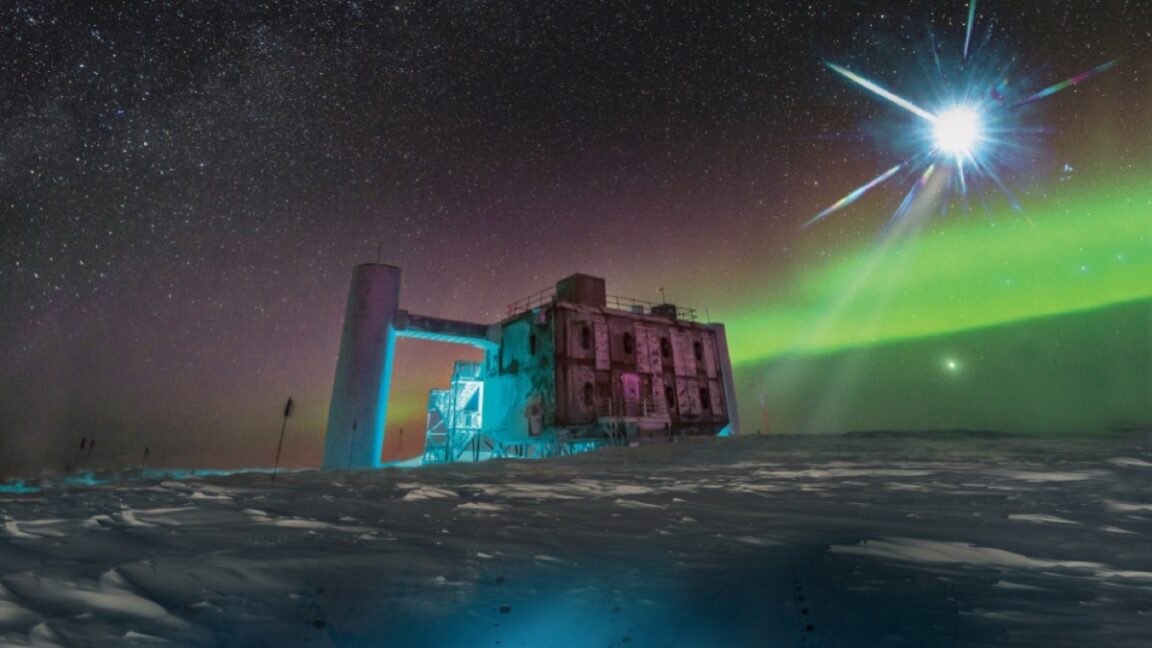
Francis Halzen has won the 2026 Nobel Prize in Physics for his pivotal role in building the IceCube Neutrino Observatory, a facility that fundamentally changed how scientists observe the cosmos by capturing some of the universe's most elusive particles.
Buried nearly a mile beneath the Antarctic ice, IceCube doesn't look like a typical observatory. There are no telescopes, no mirrors, no delicate instrumentation exposed to the elements. Instead, the detector consists of thousands of sensors embedded in the frozen water, waiting to catch the rare moment when a ghostly neutrino crashes into an ice molecule. These collisions generate a faint blue light that IceCube's photomultiplier tubes detect, creating a snapshot of cosmic events billions of light-years away.
Neutrinos are among the hardest particles to observe. Trillions pass through your body every second without interacting with a single atom. For decades, capturing them required enormous, expensive experiments. Halzen's insight was elegant: use Earth's ice as a natural detector. The larger the volume of ice, the higher the odds of catching a collision. IceCube's deployment, completed in 2010, proved the concept worked at unprecedented scale, opening an entirely new window into the high-energy universe.
The observatory has detected neutrinos from supernovae, black holes, and gamma-ray bursts, revealing astrophysical phenomena invisible to conventional telescopes. These ghostly messengers carry information about some of the most violent events in the cosmos, complementing what astronomers learn from photons and gravitational waves. Halzen's work essentially gave scientists a new sense for seeing the universe, one particle at a time.
The recognition underscores how transformative neutrino physics has become to modern astronomy. What was once considered a curiosity has evolved into an essential tool for understanding the cosmos.
Reporting based on an external source.